Imagine taking 11 days to make a trip that you could accomplish today in less than two hours by car! This was common in the late 1800s — the multiple ways to get around northern Alberta were all depending on the weather conditions.
Now picture trudging through three feet of snow in 50 below! That’s what the Hudson’s Bay Company (HBC) courier from Dunvegan had to do when he arrived at Lesser Slave Lake Post in early 1883. He found the horse keeper at the post shovelling snow to allow the horses to get to the grass.
Water Power: Boats
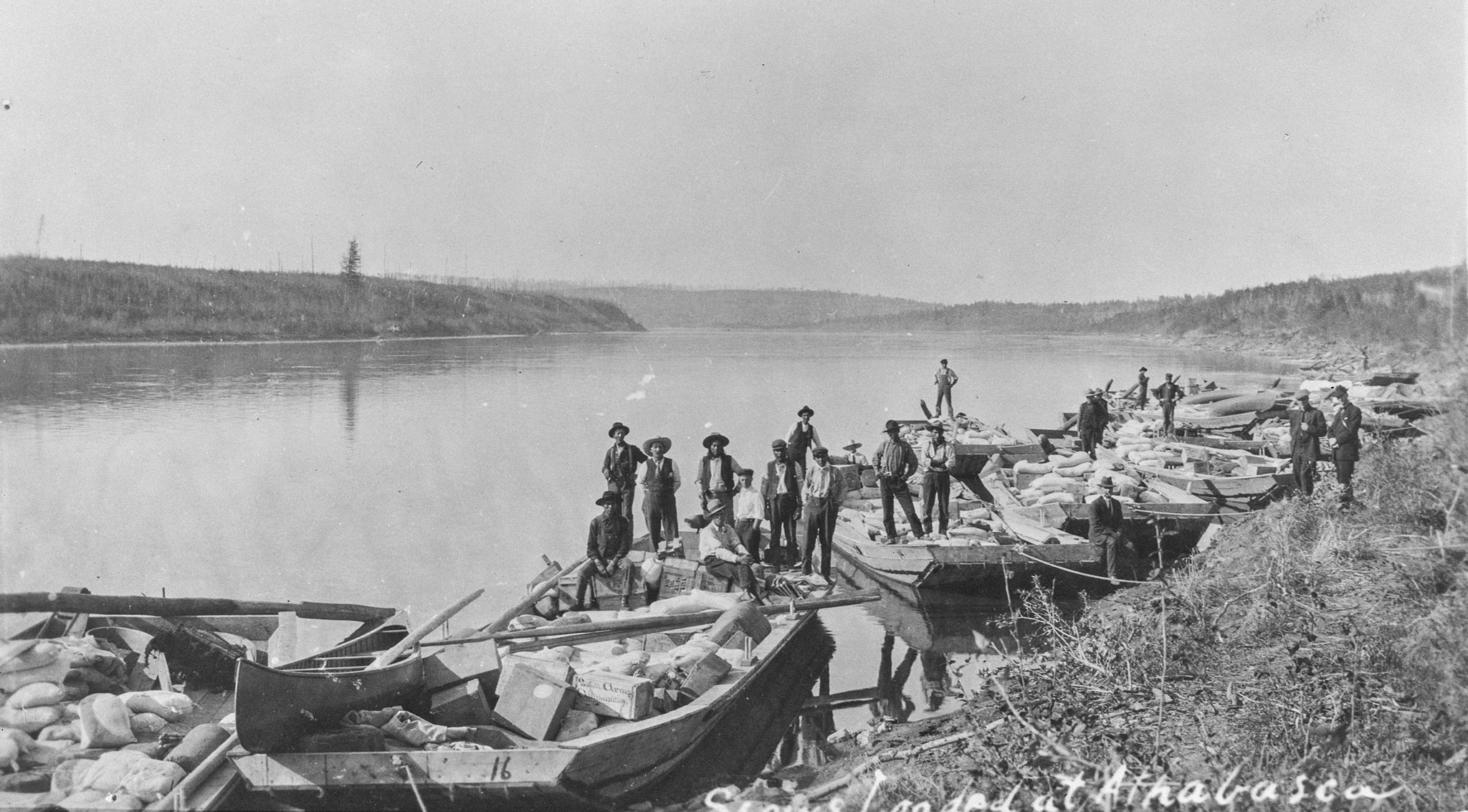
Rivers and lakes were the major highways of the day in northern Alberta. Using many types of boats, travellers were at the mercy of the water and weather — often in limbo en route waiting for the ice to freeze or thaw to cross a river. It was hazardous to go on the water in spring if it was high, since large chunks of ice moved in swift currents.
Some years the water was so high that the curves and rapids of the Lesser Slave River disappeared. In 1882, while escorting Mrs. Traill, the wife of the HBC factor at Lesser Slave Lake – along with their children to Edmonton – Alex Savard was sailing across the points instead of following the bends. It was likely quite exciting for the kids.
Typically, going up and over the rapids on the Lesser Slave River was not an easy task. On a trading trip to Lesser Slave Lake in 1885, Colin Fraser had gotten his boat up all the rapids when it turned sideways and was carried all the way to the bottom again. The water ruined his supply of tea and sugar thanks to a big hole in the bottom of the boat, and his crew was so annoyed they headed back to Edmonton. It was not Fraser’s best day.
In 1889, Henry F. Davis “Twelve Foot Davis” returned from British Columbia with a scow load of goods seen passing by the Smoky and Peace River junction. A scow is a type of flat-bottomed barge.

Credit: Provincial Archives of Alberta, Object Number A11516. No Date Available. Contributed by Mrs. E. Nancekivell.
Steam Power: Hudson’s Bay Company Steamboat in northern Alberta
The HBC planned to build a steamer at Athabasca Landing during the summer of 1886. The goal: to run the Athabasca and Lesser Slave rivers and go up the lake to the post. The boat was to have a 144-foot keel and 26-foot beam and would complete the missing link in the chain of steamboat communication from Winnipeg to the Arctic Ocean.
The steamer, named Athabasca, was finished in 1887. Making its first trial in 1888, it struck a rock in the Lesser Slave River and broke five timbers, which are critical pieces of wood used to compose the ship’s frame. The crew would repair the damage when the boat was hauled out of the water at Athabasca Landing for the winter.
A tramway was to be built on the island in the middle of the Grand Rapids for portaging goods from the steamboat above the fast-moving water to York boats below. A crew would be blasting rocks there and also removing rocks and obstructions from the river for smoother transportation. Afterward, the ship should have been able to ascend the river and go all the way to the Lesser Slave Lake Post in relatively low water.

Credit: Provincial Archives of Alberta, Object Number A4573. Date: [1913]
Animal Power: Dog Trains
Dogs were a primary means of travel in northern Alberta. To kill or injure a dog would have been far worse than stealing and demolishing a vehicle. Dogs were essential for someone’s ability to feed themselves and their family.
Several valuable dogs and many fur-bearing animals were poisoned in the winter of 1895. The use of poisoned trapping bait made many Indigenous people suspicious of white men they didn’t know.
The fur prices were high and trade was brisk in winter 1883-84. The Hudson’s Bay Company constantly had five dog trains out, moving around furs and supplies. Others were also moving around to take advantage of the prices — including two men whose names were not mentioned — who arrived in Edmonton in early January from Lesser Slave Lake with a dog train loaded with fur to trade or sell.

Credit: Provincial Archives of Alberta. Object Number A3486. Date: 1894.
Animal Power: Horses, Carts and Trails
Carts were another mode of transportation that relied on the power of animals, which horses pulled. In 1883, W. Macdonald and Noel Courtepatte delivered eight or 10 horses to transport survey supplies in the Peace River Region. After 39 days on the trail, they reached Lesser Slave Lake Post from Edmonton on May 16th. The horses were in poor condition but had all arrived alive.
The first cart brigade for the Hudson’s Bay Company started on April 21, 1883, from Lesser Slave Lake for Peace River, where seven men were taking flour and other supplies for the different posts in that region. Luckily, they didn’t have to go over any smaller bridges on the Heart River, as most had been washed away.
Athabasca Landing was the last stop for the cart road from Edmonton. This was where the HBC began to transfer their goods from land to the water routes going both up and down river.

Rumblings of Road Building
For over a decade, the government had discussed opening northern Alberta roads, citing commercial and other benefits.
In the mid-1890s, there was still no action. People called on the government to improve transportation routes into the North, which would benefit the fur trade, settlement and agricultural industry. It would also pave the way for the promotion of the “All Canadian Route” during the Klondike Gold Rush.
Travel is one of the main focuses or themes in Alberta History: Lesser Slave Lake Region: News Reviews Volume 1: 1880-1896. Learn more about travel in northern Alberta and Lesser Slave Lake Region in general. Click here to check out our latest publication.
Leave a Reply