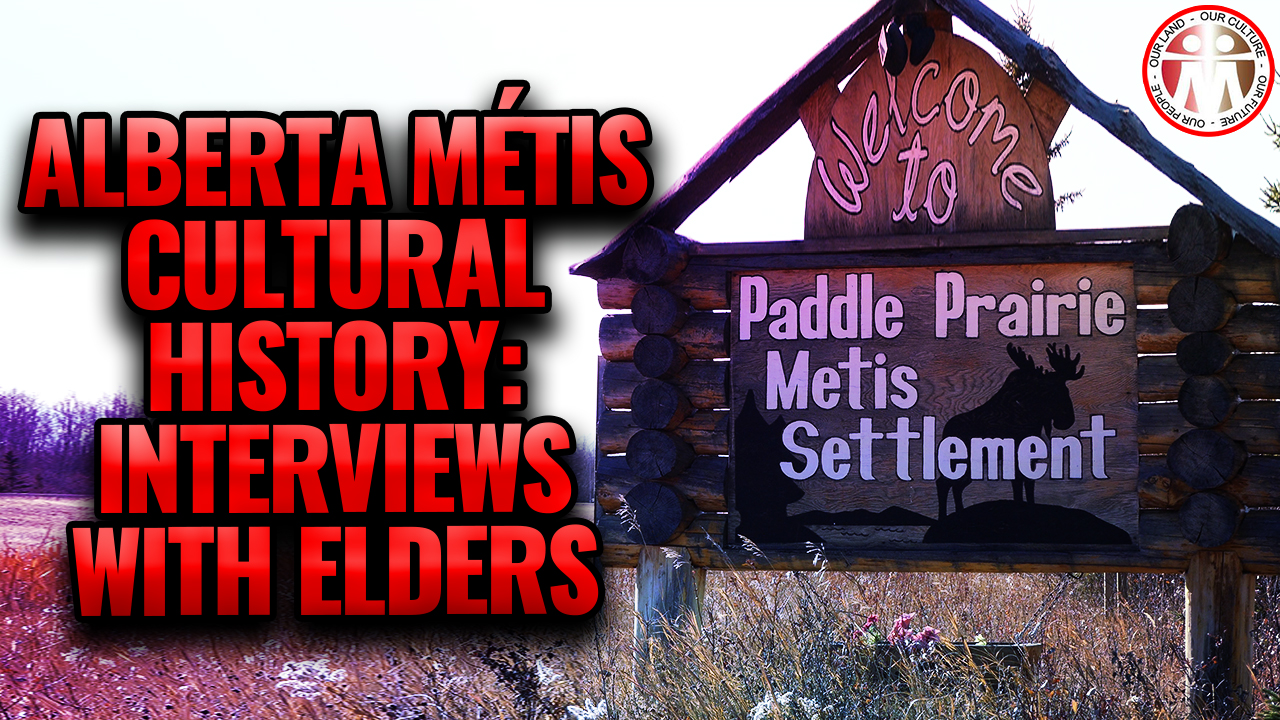
Within the rich lineage of Alberta Métis Cultural History and indigenous history overall, Emma Willets offers up her own experiences.
When asked “what does it mean to be Metis?”, Willets stated, “I guess it means that kind of like the best of both worlds. Because we are like the mixed race. We get, for me, I can take advantage of, or not advantage, but I mean I have my native culture and then for the white society, I have my education. You know, I’m thinking of the modern world to enjoy that also.”
Willets indicated a sense of worry that the culture she treasured was fading as the generations continue. An upbringing that involved bonding with parents through work, darning socks with grandmother, and a real supportive sense of communal interaction.
That being said there were certain challenges that underpinned Paddle Prairie Metis Settlement as Willets said, “Yeah, it seemed like an empty…everybody loved the challenge. They had to build their own homes. They helped one another to build each other houses and barns, and they worked together. It wasn’t…no money involved, it was just helping. If someone helped you then you helped them kind of thing. Everybody worked. They shared what they had.”
Alberta Métis Cultural History
Hunting and gathering was part of that hard working lifestyle but it became a family-oriented activity which added joy to the endeavor. Scouting, gathering berries, and curating a garden were a few examples of the activities that had that confluence of utility along with bonding.
Everything was put to good use with the hunted animals as Willets stated, “I’m not a wasteful person. Yeah, but I remember we used everything. Even the brains of the moose was used for tanning hides, my mum used to use. Everything was used, canned or dried. They never threw away the hide, that was used also for clothing or footwear. Everything I know of was used…Even the sinew was used for making the moccasins since the sinew was needed to thread. Any of the muscle of the moose.”
Beyond the accruing of meat, gathering was also important on a medicinal level with key things like mint tea, strawberry root, and balsam bark to name a few. Willet’s grandfather being “a medicine man healer” gave her a lot of localized insights into that.
The modernization of the settlement in as far as technological advancements is something Willets has noticed changing in PPMS.
Paddle Prairie Metis Settlement
In terms of tradition though, when posited with the question of “is your traditional Michif language still important to you and why?”, Willets stated, “Yes, it is very important to me. I think because if you speak any language. Your understanding of our life, it so much deeper. Life becomes more fun. There’s a lot of laughter that is missing nowadays. it’s just a bonding…It’s a bonding language for native people. Even here as soon as people know I speak Cree, it’s almost like we’re family, we just get bonded right away. And there to help you or their respect for you just changes because you are part of them. We’re a huge family.”
Finally, when asked “What is the most important things that you would want to preserve and pass on to future generations?” Willets quipped, “Life skills and also the balance of life. To be balanced physically, I always say physically, mentally, spiritually, emotionally and financially. I add on financially because I believe that if there’s a hardship of money these days you’re not balanced. We need to teach them the balance in those five rather than four, then one more time.”
Willets continued, “There’s something missing there, the spiritual balance. It’s gone. They need that to become whole. And they don’t seem to understand that. They need to be grounded. They’re not grounded if they’re not balanced alone. It’s my belief. That’s just me.”
Liberty Multimedia Inc. and Paddle Prairie Métis Settlement would like to thank Alberta Culture for its support of these interviews and dedication to preserving Alberta’s history.
Leave a Reply